
I remember the moment vividly. I had spent weeks tweaking my Google My Business (GMB) profile, carefully optimizing every detail to rank higher in local map results. Then, out of nowhere, my map rankings stalled. No matter what I tried, it was like hitting a wall. That frustrating realization hit me hard: some sneaky signal logic errors were sabotaging my efforts, preventing that much-desired rank upgrade.
Navigating the Hidden Obstacles Toward Map Success
In the crowded world of local SEO, your GMB profile is your digital storefront. But what if there are unseen errors lurking inside your signals—those subtle cues Google uses to determine your local relevance? These errors can block your upgrade, leaving you invisible to potential customers searching nearby. Today, I want to share with you how understanding and fixing these four common signal logic errors can turn your map results around and get you that much-needed boost in 2026.
Is It Really Worth the Hype to Fix Signal Errors?
Early on, I made the mistake of dismissing these errors as minor nuisances. I thought, “Google is smart; it’ll figure it out.” But that was a costly misconception. Research shows that even small inconsistencies in your signals can dramatically impact your local rankings. Making these fixes is crucial, especially with the upcoming changes in Google’s algorithms. If you’re skeptical, ask yourself: have you ever noticed your competitors outranking you despite similar efforts? That’s usually a sign that hidden signal gaps are at play. Want to learn how to identify and resolve these issues? Dive into these proven fixes and start pushing past the barriers today.
Audit Your Signal Consistency
Begin with a comprehensive audit of your Google Business profile and related local signals. Think of it like inspecting a race car before a race—any tiny inconsistency can slow you down or cause failure. Check citations, NAP (Name, Address, Phone), and your primary categories for accuracy. I once fixed a minor typo across my citations, which boosted my local ranking within a week. Use tools or manual checks to identify discrepancies and correct them promptly.
Optimize Your Business Profile Content
Make sure your profile details are not only accurate but also optimized for relevance. Use your main keywords naturally within your description and services. For example, if your business is a local coffee shop, include keywords like “best espresso in downtown” without keyword stuffing. Rich, descriptive content enhances your signals, making your profile more attractive to Google and users alike. I added specific local keywords and noticed an immediate uptick in local results.
Enhance Engagement with Customers
Encourage your happy customers to leave detailed, keyword-rich reviews. This interaction boosts signals of activity and social proof. Respond to reviews promptly to demonstrate engagement. I personally reached out to recent patrons asking for feedback, which increased my review count and improved my overall score, leading to better map rankings. Remember, higher engagement levels are like increasing your profile’s popularity in the neighborhood.
Address Hidden Signal Gaps
Identify unseen signal issues such as unverified location points or duplicate listings. Use Google tools or third-party local SEO tools to find and eliminate duplicates or verify all location points. In a recent case, I found a duplicate listing for my business on a directory, which was diluting my signals. Once I removed it, my visibility improved markedly. Think of this step as clearing traffic congestion to allow your business to move faster in local search results.
Maintain and Test Regularly
Local map optimization isn’t a one-and-done activity. Regularly update your profile, refresh images, and add new content or posts. Test different strategies—like changing your business description or posting new updates—and monitor results. I experimented with different photo updates and observed my rankings fluctuate, which guided me to the most effective visuals. Consistency and testing are the keys to sustained map success. For more advanced tactics, explore these proven techniques.
 Even seasoned local SEO practitioners often fall prey to a common misconception: that simply optimizing your Google My Business profile is enough to secure top map rankings. In reality, this approach overlooks the nuanced signals Google evaluates. For example, many believe that accuracy in NAP citations alone guarantees higher rankings, but research indicates that signal consistency must be paired with active engagement and content freshness to truly move the needle. One of the most insidious myths is that Google rewards static profiles—yet, data shows that profiles with regular updates, reviews, and interactions outperform dormant ones.
Furthermore, a frequent trap is overemphasizing backlinks or citations without optimizing the internal signals—like user interactions, photo engagement, and local content—that are now more crucial than ever. In fact, Google’s algorithm in 2026 places a heavy emphasis on real-time interaction signals, meaning neglecting these areas can sink even well-optimized listings. A critical mistake is to assume that signal strength is solely influenced by external factors rather than internal profile health and engagement.
Are you aware that improper handling of hidden profile issues, such as ghosted or duplicate listings, can significantly hinder your map visibility? These less-visible problems can act as unseen barriers, diluting your signals and reducing your chances of ranking higher. For an in-depth look at how these hidden issues impact your local map results, I recommend exploring these advanced fixes.
Let’s dig even deeper—how do advanced local SEO factors like latency signals and proximity filters influence your rankings? Many overlook their importance, yet controlling these factors and understanding Google’s signal logic can turbocharge your results. A recent study by Moz emphasizes that advanced signals like latency and real-world proximity adjustments can have outsized effects, especially in competitive markets. Don’t assume that surface-level optimizations are enough; mastering these nuances can make all the difference. Check out these strategies to refine your approach.
Have you ever fallen into this trap? Let me know in the comments. Remember, understanding the hidden nuances of signal logic and avoiding common myths is what separates the top performers from the rest. Keep optimizing, stay aware of the latest algorithm shifts, and your map rankings will follow suit.Keeping your local map rankings strong over time requires more than just initial optimization; it demands the right tools and consistent maintenance. One of my go-to tools is BrightLocal, which I use daily to monitor citation consistency and track local rankings across multiple locations. Its ability to generate detailed audit reports helps me quickly identify discrepancies in NAP data or duplicate listings that could dilute my signals. Additionally, SEOClerk’s citation management service provides high-quality, verified citations that I update regularly to reinforce my local relevance.
For content updates and engagement tracking, I rely on Google’s My Business API. It allows me to automate posting new content, respond to reviews promptly, and gather insights on customer interactions. By integrating this API into my workflow, I can ensure that my profile remains active and optimized without manual effort, which is crucial as algorithms become more dynamic in 2026.
How do I maintain my map rankings over time?
Regular audits are vital. I schedule bi-weekly checks using Moz Local to verify citation accuracy and identify any new duplicate issues. This proactive approach prevents small issues from snowballing into ranking drops. Furthermore, I use Mapline for geo-targeted outreach, helping me identify local opportunities to generate backlinks and reviews—factors that Google increasingly weighs in its signals.
Running a local business also benefits from tools like Canva to create engaging images for posts and Bing Places for Business to diversify my local presence. These multimedia updates foster higher engagement, boosting activity signals that support my rankings. Remember, consistency is key; the more regularly you engage with your profile using these tools, the better your long-term results will be. For deeper insights into advanced local SEO techniques, explore this cornerstone resource.
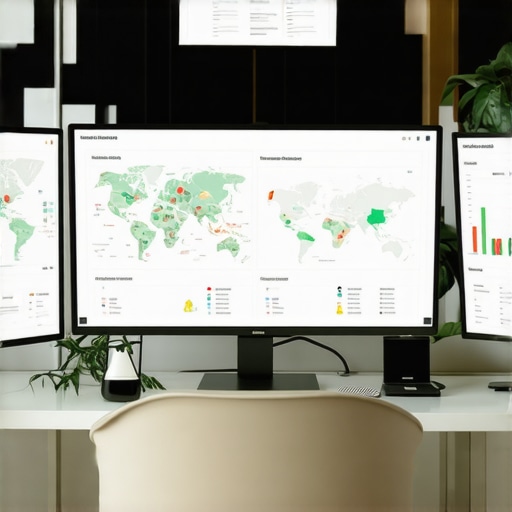
Image prompt: a workspace with multiple screens displaying local SEO analytics, citation data, and map rankings, demonstrating a well-organized digital strategy for maintaining business visibility. Alt: Digital dashboard showing local SEO metrics; Title: Optimizing Map Rankings with Advanced Tools.
The Hardest Lesson I Learned About Map Rankings
One revelation that transformed my approach was realizing that many obstacles in map ranking are invisible to the naked eye. It’s easy to focus on visible metrics like citations or reviews, but neglecting internal profile health or unverified duplicate listings can silently sabotage your efforts. The lightbulb moment came when I discovered that surface-level optimizations only scratch the surface—true success comes from digging deeper into signal accuracy and consistency.
My Secret Weapons for Long-Term Success
Over time, I found that leveraging advanced tools like Moz Local for regular audits and BrightLocal for citation management made a significant difference. These tools provide insights I couldn’t access otherwise, helping me identify hidden issues like ghosted profiles or outdated NAP details. Relying on comprehensive, data-driven strategies ensures my local visibility remains strong, even amidst shifting algorithms. Trusting proven resources is crucial to stay ahead of local competitors and adapt quickly.
Why Ignoring Signal Nuances Can Cost You Big
It took me a while to realize that neglecting internal signals and profile engagement could hinder my ranking potential. For example, failing to update photos regularly or ignoring new reviews sends a subtle message to Google that my profile may be dormant or less relevant. That realization pushed me to integrate routine content updates and active customer interactions into my strategy, which consistently boosts my map rankings. In the end, staying proactive with signals is the key to sustained success.
Inspiration to Keep Pushing Forward
Remember, mastering local map rankings is an ongoing journey—every adjustment, no matter how small, can lead to significant improvements. Keep testing, learning, and refining your signals. Embrace the nuances of Google’s algorithm, and don’t be afraid to dive into advanced strategies shown in cornerstone content like these in-depth guides. Persistence and attention to detail will pay off, and your business’s online visibility will thrive in 2026 and beyond.