
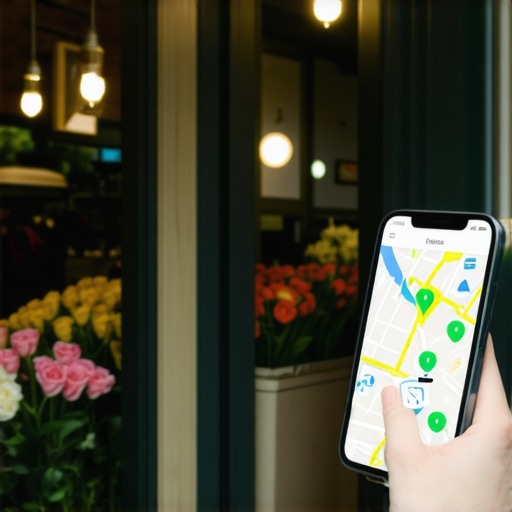
The sidewalk smells like wet concrete after a morning rain; the kind of gray morning where the reflection in a shop window tells more about a business than its expensive signage ever could. I have spent twenty years as a street photographer of the digital world, capturing the glitches and the raw storefront data that most people ignore. I do not care about your marketing brochures. I care about the forensic trace your business leaves on a spatial database. My mission is to find the reality behind the pin. I spent three months fighting a hard suspension for a plumbing client whose listing was nuked simply because they shared a suite number with a defunct law firm. Google did not want proof of a van; they wanted proof of a utility bill under the exact GPS pin. That experience taught me that the local algorithm is not a marketing tool; it is a mathematical judge. It does not care about your intent; it cares about your physical proof. If you cannot prove you exist in a specific three dimensional space, you do not exist in the search results. This is the reality of the hyper-local layer.
The ghost in the GPS coordinates
Geographic coordinates and latitude data points are the primary anchors for every Google Business Profile. These signals dictate your position within the Map Pack. Google utilizes your precise GPS pin to calculate the distance between your front door and the mobile device of the searcher. This proximity signal remains the most dominant ranking factor in 2025. I have walked past storefronts that look perfect to the naked eye but are invisible to the search engine. This happens because the underlying spatial data is fractured. If your coordinates do not align with the historical traffic patterns of the neighborhood, Google begins to treat your business like a ghost. I have seen rankings vanish because a business moved one block away but failed to update their micro-data. You need to understand the proximity fix for businesses located on the edge of a major city to combat this. The algorithm looks for the heat signature of a real business. It looks for customers stopping at your door. It looks for the math of a real location. If the math fails, the visibility dies. You must ensure your conflicting address information is resolved immediately across all databases. Conflicting data creates a spatial blur that the algorithm cannot resolve.
“Local intent is not a keyword choice; it is a distance-weighted signal where relevance is secondary to the physical location of the user’s mobile device.” – Map Search Fundamental
Why your physical address is a liability
Physical addresses can become search liabilities when they are associated with high-risk locations like virtual offices or shared coworking spaces. Google prefers standalone buildings with clear signage. Listings located in residential areas or virtual suites often face immediate scrutiny and potential suspension from the spam team. I have seen thousands of listings destroyed because an owner thought a UPS mailbox was a valid business address. It is not. Google ignores your office if it cannot see a physical entrance on Street View. This is why google ignores your physical office even when you think the data is correct. You need specific photos google support needs to prove your existence. You need pictures of the door, the lobby, and the street sign. If you hide your address, you might be killing your impressions. Many contractors find that hiding your business address often leads to a massive drop in visibility. The system rewards transparency. It wants to know exactly where the money changes hands. If you are operating from a coworking space, you are already behind the curve. The algorithm sees the shared footprint and flags it as a potential lead generation scam. You have to work twice as hard to prove you are a legitimate merchant.
The three mile radius that determines your revenue
Proximity radius limits are the invisible boundaries that define which customers can see your business in the Map Pack. Most local searches are solved within a three mile radius of the user. Expanding beyond this circle requires high levels of authority and local relevance. I often see businesses try to rank for an entire city when they only have the authority to rank for a single street corner. This is a waste of energy. You should focus on why your service area map is shrinking and how to fix it. If you try to spread your relevance too thin, you end up ranking nowhere. The algorithm detects the lack of local signals from the outer edges of your targeted area. It sees that people from twenty miles away are not visiting your store. This lack of behavioral data causes your ranking to collapse back toward the center. You need to use the toolkit every local contractor needs to monitor these shifts. If you move your business even a small distance, you must understand how to win back map impressions after moving. The center of the city is not always the best place to be. The best place to be is wherever your customers are actually standing when they pull out their phones. The distance is a physical reality that no amount of keyword stuffing can overcome.
The forensic trace of a local review
Review signals provide Google with social proof and linguistic context through customer sentiment and keyword association. High review velocity combined with local keywords creates a massive trust signal for the algorithm. However, fake reviews are easily detected by forensic patterns in user profiles. I have investigated review bombs where twenty accounts all from the same IP address left identical praise. Google sees this instantly. You need the specific workflow for removing bot generated reviews to protect your profile. If you have been attacked by a competitor, you must learn handling negative seo attacks without panicking. The real cost is not the single star; it is the loss of trust from the algorithm. Look at the real cost of ignoring fake reviews on your listing. If the system thinks your reviews are manipulated, it will shadowban your profile. You will still be live, but you will never appear in the top three. It is better to have ten honest reviews than a thousand fake ones. The algorithm reads the sentiment. It looks for words like reliable, professional, and on time. It looks for photos taken by the customers. These photos contain metadata that proves the customer was actually at your location. That is a signal you cannot fake. If you need help, look into a simple toolkit for managing local customer reviews.
Local Authority Reading List
- The Secret to Reinstatement Success
- Recovering from Ownership Transfer Errors
- Are Paid Gmb Tools Worth It?
- Impact of Review Cleanup on Rankings
- Fixing Toxic Link Profiles
Why listing ownership change kills visibility
Ownership transfers and account changes often trigger re-verification loops that temporarily strip a listing of its established authority. Google views a change in management as a potential security risk or a business sale that might change the category relevance. I have seen businesses drop from number one to nowhere because the new owner changed the primary email address. This is why your new listing ownership is killing your local ranking. The system resets your trust score to zero while it evaluates the new credentials. You must follow the path for recovering traffic after a botched transfer. If you are buying a business, do not change the name or phone number immediately. These are the anchors of your identity. Changing them too fast is like pulling the rug out from under your own feet. I have seen owners get stuck in the verification loop for months. They provide the documents, but the system keeps asking for more. This usually happens because there is a mismatch in the back end data. You need to know the real reason your reinstatement was denied before you submit the same papers again. Patience is a technical requirement here. The algorithm needs time to observe the new owner’s behavior before it restores the old ranking power. If you make a mistake, you might need google business profile recovery services to get things back on track.
The math behind local service area polygons
Service area businesses must define their reach through service area polygons rather than physical pins to rank for broad geographic terms. These polygons are defined by zip codes or city names within the business profile settings. If you set your area too wide, Google will dilute your relevance. I have seen plumbers trying to cover three states from a single home office. It never works. The algorithm knows the drive times. It knows that a service worker cannot reasonably travel fifty miles for a small job. You need to prove your service area to google after you move. If you move your base of operations, your entire ranking structure will shift. You might see a service area visibility crash if you do not handle the transition correctly. The system looks for local signals within that polygon. It looks for citations from local news sites and neighborhood blogs. If all your links are from national sites, you have no local relevance. You need to audit hidden backlink anchors to see if they are actually helping your local reach. Toxic links from other countries will kill your map pin faster than anything else. Use how to filter your backlinks to find the garbage that is dragging you down. The polygon is a boundary of trust. Keep it tight and keep it honest.
“Local search success is determined by the intersection of three factors: distance from the searcher, prominence of the brand, and the specific relevance of the category to the user’s intent.” – Vicinity Research Whitepaper
Fixing the schema errors that keep you hidden
Structured data like LocalBusiness schema provides a machine readable map of your business details for search engine crawlers. Errors in this code can lead to a total loss of visibility in AI overviews and rich search results. I have seen websites that look beautiful but are invisible to Google because the schema is broken. You must be fixing the schema errors that keep you hidden. The most common mistake is a mismatch between the website data and the business profile data. If your phone number on the site is different from the number on the map, Google will lose trust. You need to know the move that fixes inconsistent nap data. NAP stands for Name, Address, and Phone number. It must be identical everywhere. I once audited a client and found forty different phone numbers across various directories. We had to spend weeks scrubbing old business phone numbers off the web. This is the heavy lifting of local SEO. It is not glamorous, but it is the only way to win. If you have duplicate listings, you are splitting your authority. You must understand the hidden impact of duplicate listings. They do not give you more space; they make you look like a spammer. Clean up your data and the rankings will follow.
The toolkit for map dominance
Map ranking toolkits provide the diagnostic data necessary to identify ranking drops and competitor spam attacks. These tools allow you to see the Map Pack as the algorithm sees it, revealing hidden filters and proximity shifts. I use these tools to find the competitors who are cheating. If you see a business ranking with a keyword stuffed name, you should learn the exact way to report a fake business. Keyword stuffing leads to a ranking drop eventually. You need the toolkit strategy for agencies to keep your data clean. Most tools fail in competitive markets because they do not account for the human element. You have to verify everything with your own eyes. Look at everything inside the gmb ranking toolkit we use. It is about more than just tracking; it is about auditing the reality of the street. If your map pin disappeared, look for why your business map pin disappeared. Usually, it is a simple error that a good audit will find. Do not guess with your revenue. Use the data. The sidewalk does not lie, and neither does the GPS coordinate. Success in the Map Pack is a result of forensic precision and persistent data hygiene. Keep your storefront real and your data even realer.